Renée Qin – British Columbia
harpist . composer . multimedia artist
Winter. I think I would choose winter.
I have always loved snow. Vancouver winters do not always hold snow for long, but in West Vancouver, up on the mountain, we often had snow. As a child, I remember waking up after snowfall and hoping school would be cancelled, though most of the time it still stayed open. Even so, the snow changed the feeling of the day.
I remember one snowfall in particular when I filmed the snow on my phone and later turned the video into slow motion. Watching the snowflakes fall as if they were almost suspended in the air felt incredibly beautiful to me. That sense of stillness has stayed with me.
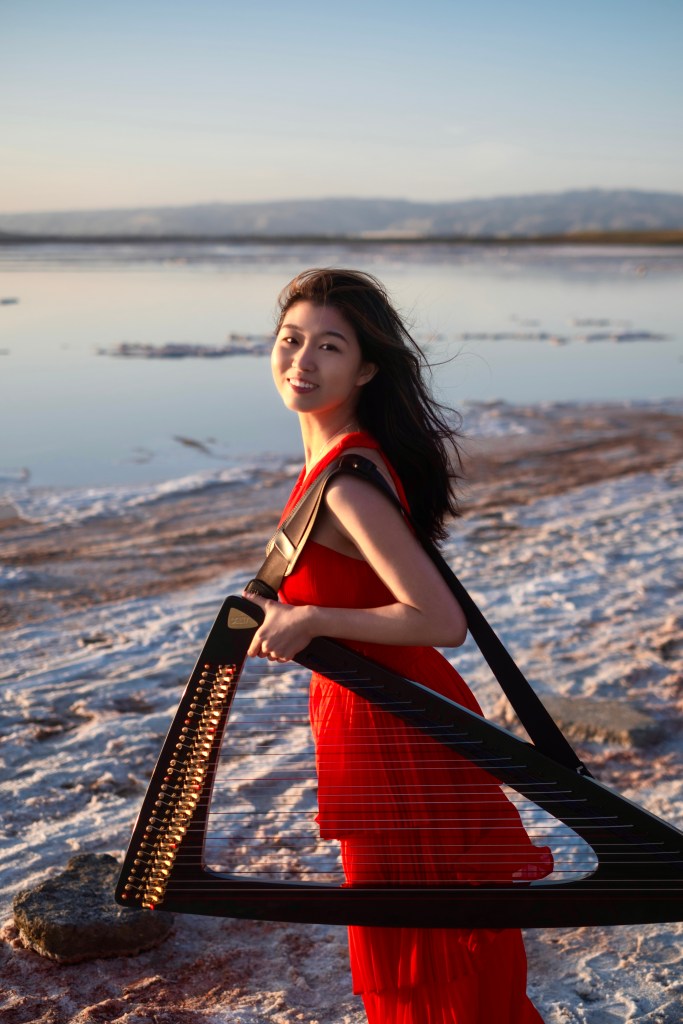
It feels close to what I search for in music. The harp can hold a quiet luminosity — delicate, reflective, spacious, and full of feeling beneath the surface. Much of my work is drawn to water, light, memory, and atmosphere, and winter gathers those elements in a way that feels calm and deeply peaceful.
Winter also reminds me of Canada: silence, distance, brightness, and the feeling of a landscape inviting you to listen more closely. – Renée
Oh Canada
Canada is where my relationship with the harp began. I grew up in West Vancouver, in a home on the mountain overlooking the ocean, and my earliest sense of music was shaped by the landscape there: rain, ocean, mountains, changing light, shooting stars, fireworks over the bay, and the feeling of being close to both nature and distance. Even as my work has moved toward technology, visuals, and interactive systems, I still feel that my musical language carries something from the West Coast of Canada – spaciousness, atmosphere, water, and light.
Throughout my teenage years, my life was filled with music. I served as principal harpist of the Vancouver Youth Symphony Orchestra, in addition to playing at Lions Gate Youth Symphony and West Vancouver Youth Band. I remember I played many community concerts across the Metro Vancouver area, and those experiences gave me some of my earliest memories of sharing the harp with others.
Harp Mentors
I studied harp in Vancouver with Elizabeth Volpé Bligh until I moved to the United States for college.
I also attended the Curtis Institute of Music’s Summer Harp Colony, where I was mentored by Judy Loman and Elizabeth Hainen. I later continued my studies with Elizabeth Hainen through OAcademy Conservatory, where she served as Head of the Harp Studio.
After moving to the Bay Area to study at Stanford University, I briefly studied with Douglas Rioth before his retirement. At Stanford, I continued my harp studies with Dan Levitan and studied music composition with Dr. François Rose. I have also received additional coaching from Katherine Siochi at the San Francisco Conservatory of Music.
Harp Explorations
Stanford also opened a new direction in my artistic education. Through the Center for Computer Research in Music and Acoustics (CCRMA), I began developing the artistic and technical tools to connect classical harp technique with live interactive systems, visual media, and technology-driven performance.
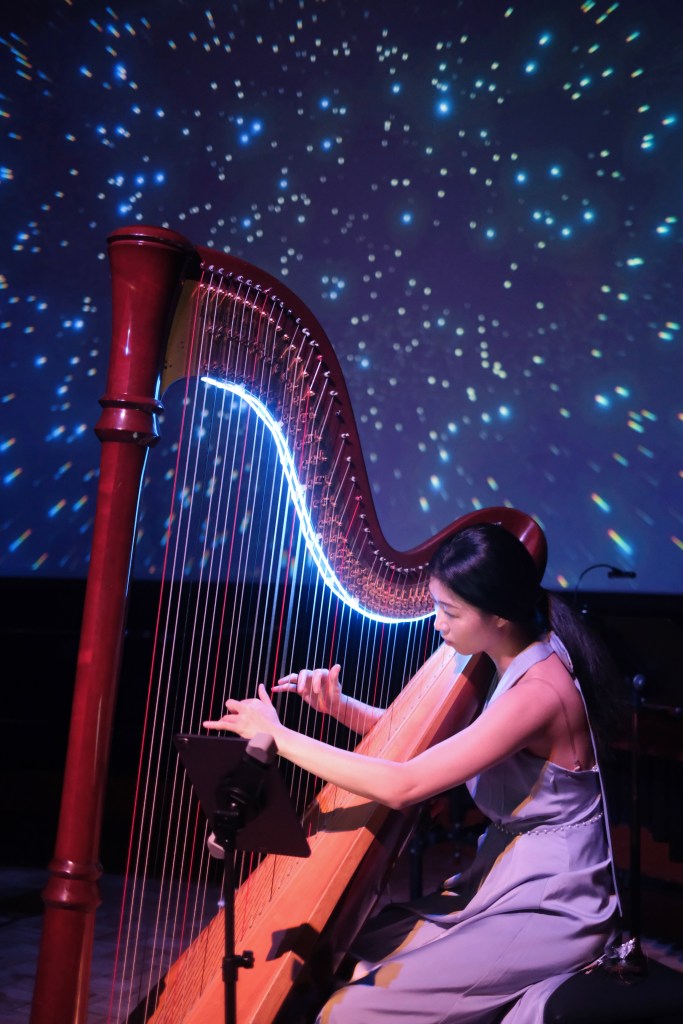
My current work explores how the harp can live inside interactive worlds. I combine acoustic harp performance with electronics, visual media, soundscapes, audience participation, and interactive technology. I am especially interested in moments where the audience is not only watching a performance, but gently shaping what is heard and seen.
Further Explorations
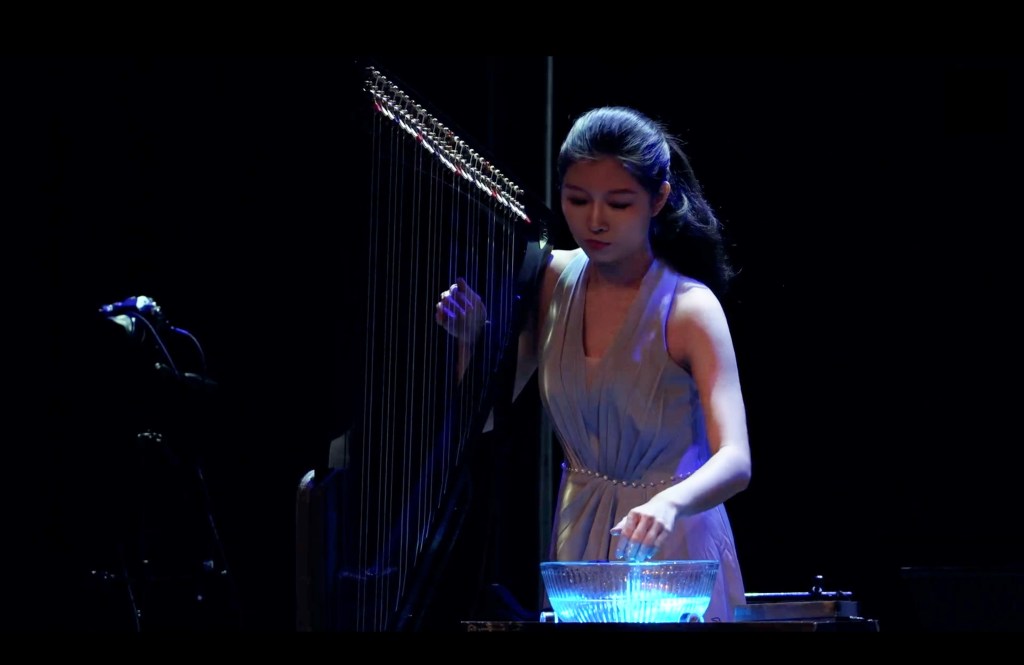
- Handmade water instruments, where water becomes a live sound source
- Audio-reactive visuals coded in ChucK and ChuGL
- Audience phone flashlights shaping sound and visuals in real time
- AI-assisted voice-generated soundscapes and visuals, combined with live harp improvisation
At the center of these explorations is still the harp: its resonance, touch, color, and ability to hold both intimacy and atmosphere. Technology expands the world around the instrument, but the harp remains the emotional voice that I want to connect with the audience to the experience.
Work samples:
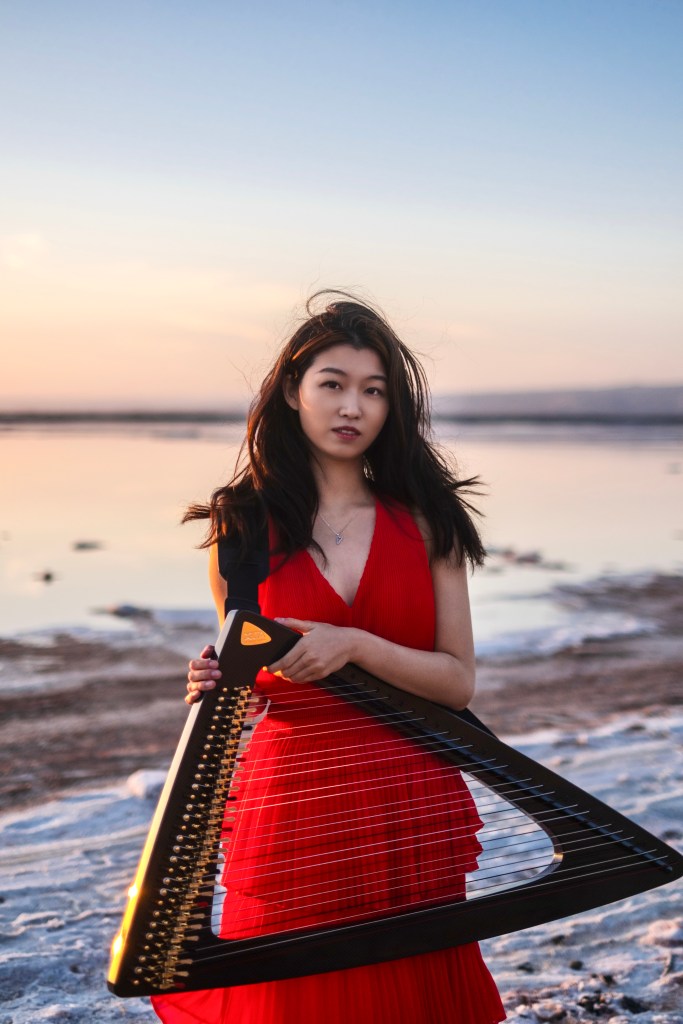
Renée Qin is a Canadian harpist, composer, and multimedia artist whose performances bring classical technique into dialogue with evolving visual and technological worlds.
Classically trained as a harpist, Qin grew up in West Vancouver, where she was drawn early to the storytelling power of sound. Before developing her own multimedia works, she explored this fascination through arranging music from Studio Ghibli films for harp, composing soundscapes for her own videos, and rescoring animated films. These early experiments planted the seeds for pairing sound with image, an impulse that has grown into a fully realized artistic practice where sound, visuals, and presence reveal a shared narrative.
At Stanford University, where she earned a B.A. with Distinction and Honors in Music and Economics, Qin began expanding her musical language through technology and interdisciplinary research. Immersed in the creative environment of Silicon Valley and Stanford’s Center for Computer Research in Music and Acoustics (CCRMA), she continued into graduate study in Computer Science and developed a practice that connects acoustic performance with interaction, visual design, live systems, and audience participation.
Central to Qin’s artistry is the belief that listening can be participatory. In her recent works, audiences help shape the unfolding performance through light, spoken input, touch, and collective presence. In The World We Speak Into Being, audience words grow into an AI-assisted soundscape; in Symphony of Lights, the glow of audience phones influences musical texture and color; and in Beneath the Waves, Beyond the Stars, the harp becomes the emotional anchor of an immersive journey through memory, water, technology, and the cosmos.
Named one of CBC Music’s “30 Hot Canadian Classical Musicians Under 30,” Qin has appeared at venues including Carnegie Hall, Bing Concert Hall, the Curtis Institute of Music’s Field Concert Hall, and TivoliVredenburg in Utrecht. Her work spans concert halls, community spaces, and interdisciplinary settings, reflecting a practice shaped by classical musicianship, technological imagination, and a belief in listening as a shared act. For Qin, the harp is not only an instrument, but a point of departure: a voice through which acoustic tradition, technology, and human presence can meet.
Renée Qin is presented by Stanford Live as part of its 2026–27 season. She currently lives in the San Francisco Bay Area.
Recent works